
How Did Negro League Teams Fare Against Major League Teams?
Cy Young/Bullet
Rogan Rankings
Who were the top pitchers in Negro Leagues baseball? I set out to answer that question by finding the best pitchers from every Negro League season that is recognized as a Major League. I applied the Cy Young, a modern award that was first given out in 1956 in the MLB, to the Negro Leagues. This page presents the results of this exploration, which should be fascinating to lovers of baseball, statistics and history.
Methods
1. Creating the Model
I created a data set of Cy Young Voting from the last 10 years (2014-2024, excluding the pandemic-shortened 2020 season) in the MLB. Since a Cy Young is determined for both the American League and the National League, this gave me 20 rankings. I removed relief pitchers from the data, as they pitch much fewer innings than starters. I also removed two outliers: 2021 Corbin Burnes and 2021 Jacob DeGrom. The data set includes the following statistics: ERA, Innings Pitched, Wins, Strikeout Rate, Total Strikeouts, WHIP. and Cy Young vote total. For each ranking, I averaged each statistic (except the Cy Young vote total) over the ranked players, and then calculated how much better each player was compared to the average in each statistic. For innings pitched, if the average was 180 and a player threw 200 innings, I calculated their "IP.Adj" to be 100*200/180= 111.11. After setting these statistics as predictors in R, I used them to model the number of Cy Young votes the player received. I came away with this model:
597.0419+(2.6724*ERA.Adj)+(2.0862*IP.Adj)+(1.0528*K.Adj)+(0.6412*W.Adj) = Cy Young Votes
This model uses ERA, Innings Pitched, Total Strikeouts and Wins. It has an R^2 of 0.7697 and predicts almost all of the previous 20 Cy Young winners correctly.
Click here to download the data set. Ignore the "Predicted" column and the "Stat" column. Both were a result of initial experimentation.
2. Applying the Model
I then applied this model to the Negro Leagues. The idea was that I could find out what the Cy Young rankings would have looked like for the Negro Leagues if modern voting criteria was used. I created rankings for every Negro League that the MLB has deemed to be a Major League. These are as follows:
Negro National League I (1920-1931)
Eastern Colored League (1923-1927)
American Negro League (1929)
East-West League (1932)
Negro Southern League (1932)
Negro National League II (1933-1948)
Negro American League (1937-1948)
The ECL is recognized as an official major league for its 1928 season, however intra-league data was limited for this season on seamheads.com. Therefore, it was difficult to determine a minimum number of innings pitched for a pitcher to qualify. As a result, no Cy Young ranking is included for the 1928 ECL.
The statistics used are from games between Black, major league caliber teams. Data was taken from the original Negro Leagues database, seamheads.com. The data was collected from individual box scores that were present in old newspapers. For more clarification as to what types of games the data I used is from, here is a quote from seamheads founder Gary Ashwill: "They do include league games, interleague games (there were usually two major Black leagues operating at any one time), and games against strong independent teams that we believe were comparable to league teams." Games against MLB teams or semipro teams are represented as separate leagues in the seamheads database.
Since the modern MLB Cy Young rankings include a fraction of the total number of of pitchers from any given year, I needed a way to pick candidates to use the model on for the Negro Leagues. For each league, I started by collecting all qualified pitchers from a given season. To do this, I used the 1 inning per game rule. Pitchers in the modern MLB must throw 162 innings to be qualified, since 162 games are played. For the application of the model to a Negro League, I averaged the number of league games that each team played (teams played a varying number of games) and used that as the minimum number of innings for a pitcher to be qualified. From there, I needed to narrow down the number of candidates. I used the formula to rank them, and then removed the bottom half of the ranked pitchers. This is because the highest percentage of qualified pitchers that were ranked in Cy Young voting in the modern data was 48% (roughly half). If there were fewer than 7 qualified pitchers, I took the top 7 pitchers in innings pitched as candidates. This is because the fewest number of ranked pitchers in the MLB dataset was 7.
Then, I totaled the number of predicted votes. If it was between 469 and 533, then these would be the final candidates I would rank. This was because the number of candidates would theoretically be most accurate when the model returns a reasonable number of votes. 469 and 533 were calculated by using the 1.5*IQR rule on the modern data, so that range is generally where the total number of votes fell in the MLB data. I kept narrowing down the number of candidates (and re-ranking them using the formula) until the number of votes fell within this range. To narrow down the number of candidates, I removed any pitcher that received negative votes from the model. Each time I removed pitchers from the data, I recalculated the statistics, since they are adjusted based on the averages of the pitchers that are present in the data. Then, I re-ranked the pitchers. If the vote total fell below 469, pitchers were added back into the rankings one by one until the vote total was between 469 and 533. If no ranking of pitchers produced a vote total in this range, the ranking with the closest vote total to the range was used.
Once the vote total was within range, the candidates were ranked and I had their predicted vote totals. If there were pitchers with negative vote totals at this point, I converted their votes to positive numbers. For the modern data, the average number of votes that a player the model predicted to have a negative vote total received was 3.33. So, to convert the vote total to a positive number in the Negro Leagues data, I used the following formula:
(10 - (negative votes) / all negative votes added up * (number of negative vote recipients * 3.33)) / 2
If the next highest finisher had fewer votes then the number of negative vote recipients multiplied by 3.33, then the number of negative vote recipients multiplied by 3.33 was added to the next highest finisher's vote total. (This was to ensure that the pitchers would remain in the same ranking order while negative votes were being converted to positive votes). If negative vote totals were converted to positive vote totals, then the total number of votes increased. To combat this, I calculated the percentage of the new vote total each pitcher received and multiplied each percentage by the original total number of votes (from when there were negative vote totals). This got me the final vote totals.
There were a lot of variations on this process that I tried, and some setbacks along the way, but this is the version I settled on using.
Some R Output

Here is the summary of the model. The coefficients for each variable are under the "Estimate" column. The rightmost column displays the p values of the F test, which are the probabilities that the coefficient estimates are not significant. The p values are all extremely low.

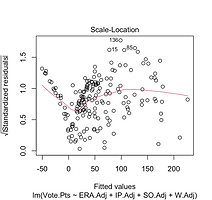

These plots demonstrate that the model meets the assumptions of linear regression well. The QQ plot shows that the error is distributed normally, while the relatively flat kernel smoother in the Scale-Location plot indicates homoskedasticity. The Residuals vs Leverage plot reveals no high leverage points that are heavily influencing the model.
Remember, this model was created using 10 years of modern MLB data. It's application to the Negro Leagues is shown below.
Below are the Cy Young/Bullet Rogan Rankings, which will be renamed to simply the "Bullet Rogan" rankings partway through the next section.There is a short write-up for every league from 1920 to 1929. Beyond those years, rankings are shown, but no write-up is present. This page will be updated with write-ups for all leagues through 1948 in the future.
Bullet Rogan Rankings
Clicking on the image of each ranking will bring you to the front page of the league for the given year on seamheads.com.
1920
Negro National League I

The Chicago American Giants finished 1st in the NNL in 1920, with a 45-15-2 record. This was due in large part to LHP Dave Brown's sensational 1.72 ERA across 141.2 innings. It is unknown how Brown's baseball talent emerged, but his career started in 1917 with the Dallas Black Giants. His catcher that year was Jim Brown, and the pair became known as the "Brown Battery". In 1919, Rube Foster, signed the Brown Battery. to play for the Chicago American Giants. Foster had been one of the greatest pitchers in Negro League Baseball, pitching from 1902-1917 and recording a career 2.32 ERA. In 1911, he founded the Chicago American Giants, and was instrumental in the founding of the first Negro National League in 1920. His signing of Brown proved to be a good one, as the lefty comfortably takes home the first "Cy Young" Award for the Negro Leagues.
Dave Brown's teammate Tom Williams makes his only career appearance on the Cy Young leaderboard, finishing third. Williams' career began in 1916 and ended just five seasons after the birth of the NNL in 1924. Sam Crawford utilized his fastball and knuckleball combination en route to a second place finish and a league leading 14 wins. His teammate Rube Curry finished second in the league in innings pitched, as the two formed a formidable duo for the Kansas City Monarchs, who finished third in the NNL with a 42-35-2 record. Fourth place finisher Bill Drake led the league in innings pitched, but the St Louis Giants struggled to a 33-39 record.
1921
Negro National League I

Dave Brown was dethroned as the top pitcher in the NNL by "Bullet" Joe Rogan in 1921. Rogan was a two-way player, and quite possibly the greatest one of all-time. From 1912-1915, Rogan established himself as an elite ballplayer while in the 24th Infantry. He began pitching in 1915 after he switched to the 25th Infantry, stationed in Hawaii. After being honorably discharged in 1920, Rogan signed with the Kansas City Monarchs. Monarchs' owner JL Wilkinson had seen Rogan play in 1917, and didn't miss the opportunity to sign him three years later. The nickname "Bullet" likely came from Rogan's exceptional fastball. Along with Rogan's 1.82 ERA in 1921, he slashed .302/.382/.471 for an .853 OPS and a 144 OPS+. Brown's Chicago American Giants would once again finish first in the NNL, with Rogan's Monarchs coming in second.
Jose Leblanc, ace of the Cuban Stars, improved his 7th place "Cy Young" finish in 1920 to a 3rd place finish in 1921. After playing in Cuba for the 1918-1919 Cuban League Season, Leblanc had established himself in the US during the 1919 season. Leblanc was a right-hander who threw a spitball, and by 1921 had evidently become one of the top pitchers in the Negro Leagues. Sadly, he would die in 1922 after an argument in an Independent League game in Cuba ended with him being struck in the head with a bat.
Dave Brown and 4th place finisher Bill Drake would face off in a pitcher's duel on August 14, 1921. As the two "Cy Young" Award candidates battled, it was not a surprise that both pitchers had a no-hitter going through six innings. Drake gave up a single to Bingo DeMoss in the bottom of the 7th, but the game remained scoreless until the 8th. It was in the bottom of the 8th that Drake surrendered the first and only run of the game, as Cristobal Torriente scored on a squeeze play for Chicago. Brown had retained his no-hitter through 8 innings, but Sam Bennett singled for St. Louis to lead off the 9th. Bill Drake batted next, but was unable to help his cause on the mound, as he grounded into a double play, putting Brown one out away from a complete game shutout. After Doc Dudley singled, catcher George Dixon caught him stealing second base, sending Chicago to a 1-0 victory over St. Louis. The Chicago Defender called it a "humdinger of a pitchers’ battle."
1922
Negro National League 1

Rogan’s reign as the top pitcher in the NNL continued in 1922. He led the league in strikeouts, recording 113 over 186.2 innings. Brown was similarly dominant, with 103 strikeouts and a slightly lower ERA than Rogan. However, Rogan pitched 31.2 more innings than Brown, giving him the edge in “Cy Young” voting. Rogan and Brown faced off in an early season marquee matchup, a game that drew a raucous crowd of 16,000. The fans saw the pitcher's duel that they expected, with the game tied at 2 in the 8th inning. However, the rowdy fans would not let the players finish the game, as they spilled onto the field in the 8th inning. The game was declared a tie.
Fourth place finisher and Kentucky native Jim Jeffries led the league in wins and inning pitched for the Indianapolis ABCs. Jeffries was a southpaw who was a clear workhorse, recording 394 innings pitched in the NNL from 1921 to 1922. Chicago American Giants pitcher Juan Padron debuts on the Cy Young rankings in his first season in the NNL. Little is known about Padron, but he had been pitching for independent clubs since 1915. In 1916, he recorded an incredible 1.58 ERA and 198 ERA+ over 193.1 innings while pitching for the Chicago American Giants and Cuban Stars, who at that point were independent clubs. This isn't the last we'll see of Padron.
If the MVP award had been given out in 1922, it would almost certainly have gone to Bullet Rogan. On top of his dominance on the mound, he recorded 280 Plate Appearances in which he hit .370 with 15 home runs, second most in the league to Oscar Charleston. His 1.120 OPS ranked 3rd in the league, just behind Heavy Johnson and Charleston. When Rogan wasn't on the mound, he manned center field for the Monarchs.
1923
Negro National League I

From now on, instead of the "Cy Young" Award, let's call it the "Bullet Rogan" Award. Rogan finishes 1st for the 3rd consecutive season in the NNL, tossing an astounding 248.1 innings in 34 games (24 games started). Incredibly, Rogan pitched 20 complete games. The Monarchs were firing on all cylinders in 1923, finishing first in the NNL with a 59-36 record. Their pitching staff was unmatched, as four of their pitchers finished in "Bullet Rogan" Award voting. Rogan's teammate Rube Curry received "Bullet Rogan" votes for the fourth straight year, finishing a personal high of 2nd in 1923. Curry's consistency was certainly remarkable, as was his curveball. He finished second in the league in K/BB ratio, recording 2.25 strikeouts for every one walk. The only man better in that department was 9th place finisher Juan Padron, who struck out 2.29 batters per walk.
Ed Rile, the only Chicago American Giant in the 1923 "Bullet Rogan" rankings, led the league in ERA. Rile's season was perhaps highlighted by a 1 hit shutout he threw against the St Louis Stars, a game which the American Giants won 2-0. Bill Drake received votes for the 3rd time in the first 4 years of rankings. Drake was known for throwing inside to hitters, which was clearly an effective strategy for him. Once again though, it was Rogan who stole the show, as he added a .967 OPS (151 OPS+) in 230 Plate Appearances to his stellar pitching statistics.
Eastern Colored League

The inaugural year of the Eastern Colored League (ECL) saw Nip Winters take home the Bullet Rogan award in a tight race against Rats Henderson. Both Winters and Henderson were stars in the ECL for many years, so this is not the first time they're seen at the top of the Bullet Rogan rankings. Before 1923, Winters was already a star in independent baseball, where his professional career began in 1920. By 1923, Winters already had 2 No-Hitters to his name. Standing 6 feet and 2 inches tall, Winters was a physically imposing presence on the mound. He was a left-handed pitcher with an impressive curveball. Winters was certainly a dominant pitcher, but did sometimes struggle with his command; His 8.4% walk rate in the 1923 ECL was 1.4% above the league average of 6.5%. Winters could also play first base, and was a capable hitter as well, posting a career .795 OPS, 106 OPS+ and 14 home runs against Negro League competition.
Rats Henderson was about as durable of a pitcher as you could find in the Negro Leagues. Henderson pitched 1063.2 innings for the Atlantic City Bacharach Giants from 1923 to 1929, which is roughly 152 innings per season. His sheer volume of work in 1923 earns him 2nd place in Bullet Rogan award voting.
Nip Winters played with Hilldale Club's Phil Cockrell in the winter before the 1923 season in a hotel league in Florida. Winters tagged along with Cockrell to the Hilldale Club for the 1923 season. Cockrell, Winters and Red Ryan formed an elite trio for the Hilldale Club, leading them to a 34-20-1 record in the ECL, good for 1st place. The Bacharach Giants' trio of Rats Henderson, Hubert Lockhart and John Harper had less fortune, as the Bacharach Giants finished 4th in the ECL with a 21-24-1 record. This was primarily due to a lackluster offense that scored the fewest runs per game in the ECL at 4.9. 8th place finisher Lucius Hampton pitched just 27.2 innings for the Bacharach Giants before becoming a member of the Hilldale Club, adding to their star-studded pitching staff.
1924
Negro National League I

Rogan finishes 3rd in the 1924 NNL rankings despite leading the league in wins. Rogan's regular season performance may have been shadowed by his play in the 1st Negro League World Series, which the Monarchs reached after achieving the NNL's top record in 1924. Sam Streeter and Juan Padron finish just 20 votes apart, with Streeter's larger volume of work earning him 1st place. Streeter was left-handed, and his nickname was fittingly "Lefty". He was not a hard thrower, and relied on his curveball. Streeter had remarkable command, as evident by his miniscule 3.2% walk rate in 1924, significantly lower than the league average of 8.1%. At times he was said to have doctored the baseball with banned substances, and was once ejected from a game for rubbing too much dirt on a baseball. Streeter was on the Birmingham Black Barons, who were playing in the NNL for the first time in 1924. He had grown up just 120 miles north of Birmingham in New Market, Alabama.
Juan Padron led the league in ERA, which nearly earned him the "Bullet Rogan" award. Remarkably, Padron did not allow a single home run in the 1924 NNL season. Sam Streeter gave up 9 home runs, as did 4th place finisher Bill McCall. Rogan came close to matching Padron's ridiculous feat, but gave up 2 home runs himself.
Eastern Colored League

With Rats Henderson throwing only 70.1 innings in the 1924 ECL (a mark that was very low for him), Nip Winters found new competition in 1920 NNL Bullet Rogan winner Dave Brown. This is the last time Dave Brown appears in Bullet Rogan rankings. In 1925, Brown was in the presence of a murder in the early hours of the morning when out with two of his teammates. Accounts of the event vary, and it is unclear whether Brown was the assailant. Nevertheless, Brown went on the run, afraid of being suspected of murder. He undertook the name "Lefty Wilson", and continued his baseball career playing for semipro teams. Brown has recently been found to likely have been innocent of the crime. He finished his major league career with three 2nd place Bullet Rogan finishes, and one Bullet Rogan award.
Brown was the only roadblock to Winters taking home the Triple Crown (a feat achieved by leading the league in Wins, Strikeouts and ERA). Brown barely bested Winters in the ERA department. However, the Hilldale Club and Nip Winters would finish 1st in the ECL, setting up the first Negro League World Series. They would play Bullet Rogan and the Kansas City Monarchs, who had finished 1st in the NNL in 1924. The Monarchs won the series 5-4 in 10 games, with one game finishing in a tie. Rogan led the Monarchs in innings pitched with 28, recording a 2-1 record and a 2.89 ERA over the series. It should also be noted that Rogan record a team-high 6 RBIs over the course of the series. Jose Mendez, who finished 8th in the NNL Bullet Rogan voting in 1923, also recorded 2 wins for the Monarchs. William Bell earned a win for Kansas City as well. Phil Cockrell earned the game 1 nod for the Hilldale Club, but it was Nip Winters that earned 3 of the Hilldale Club's 4 wins, throwing 38.2 innings and posting a 1.63 ERA. Rube Curry, who had played for the Monarchs in 1923, also earned a win for the Hilldale Club. But it wasn't enough to beat Rogan and the Monarchs, who proved themselves as the top team in Negro Leagues baseball in 1924.
1925
Negro National League I

This one isn't close. Bullet Rogan shook off a "down" year in 1924, when he finished 3rd in the rankings, to turn in the most dominant pitching season in the history of the Negro Leagues to this point. Rogan's 1.74 ERA translated to a 281 ERA+. He also recorded 4 shutouts, and lost just 2 decisions all season. This is already Rogan's 4th Bullet Rogan award, as he lives up to its name. Rogan tallied 145 Plate Appearances as well, slashing .360/.424./.592 for a 1.016 OPS and a 178 OPS+. He hit 2 home runs, 7 doubles and 8 triples.
Left-hander Andy Cooper is a name to point out. This is his 3rd consecutive year finishing in the Bullet Rogan rankings for the NNL. He's the only Detroit Stars pitcher to finish in the rankings over the last two years. Cooper was a member of the military, and was stationed in France during World War 1. He began to make a name for itself upon his return from service while pitching for the Wichita Colored Giants in 1919. Cooper signed with the Detroit Stars in 1920, and pitched with them through 1927, at which point he joined the Kansas City Monarchs. A scouting report on Cooper by Negro League legend and storyteller Buck O'Neil read, "Live arm, running fastball, ¾ arm action with a tight curveball, total command of all pitches." Cooper would manage for the Monarchs from 1936 to 1940, but it was in Detroit that he had become a true legend of the game.
Eastern Colored League

In the closest finish to date, Rats Henderson takes home his first Bullet Rogan award. Henderson's durability on the mound was on full display in 1925, as he tossed the most innings in the ECL history with 228.1. In most years, Nip Winters' 17 wins and 200 innings pitched would have been enough to take home 1st place, but not this year. 3rd place finisher Bob McClure makes his first and only appearance in Bullet Rogan rankings. Standing at 6 feet and 1 inch tall and 185 pounds, the right-hander was nicknamed "Big Boy".
Phil Cockrell, whom Nip Winters had tailed to the Hilldale Club in 1923, turned in another strong performance in 1925. Cockrell had been discovered by Pop Watkins, a Black ballplayer from the early 1900s who had turned his focus into the assembly of Black baseball teams. Watkins would form teams in the South and travel north for competition. Cockrell starred for Watkins' Havana Red Sox from 1914 to 1917, which was based in Watertown, New York. Cockrell then signed with the Hilldale Club in 1918, where he would play until 1932. Cockrell was famous for his outstanding spitball. He was a crafty pitcher, finding the weaknesses of batters and relying on his wits as opposed to physical dominance.
1925 saw the Hilldale Club top the Kansas City Monarchs in the Negro League World Series in a rematch from the 1924 championship. Cockrell pitched the final game of the series, a 6 strikeout complete game in which he only surrendered 2 runs. The Hilldale Club won the series 5-1. Cockrell, Nip Winters and Red Ryan each recorded 1 win, while Rube Curry recorded 2 for the Hilldale Club. Nelson Dean, the 2nd place Bullet Rogan finisher in the NNL, beat Phil Cockrell for the Monarchs only win in the series.
1926
Negro National League I

A new star emerged in the NNL in 1926 in Willie Foster. Foster had been in the league since 1923, but his season high in innings before 1926 was just 78. Willie Foster was the brother of Rube Foster, the legendary pitcher who signed Dave Brown to the Chicago American Giants and was the president of the NNL. However, it was Willie Foster that was quite possibly the greatest left-handed pitcher in the history of the Negro Leagues. Buck O'Neil reported that Foster mainly threw a heavy sinker and curveball. As a younger pitcher, he is said to have relied on his high velocity, while he later added offspeed and breaking pitches. Rube Foster had encouraged his brother Willie to focus on his education, but Willie eventually found his way to the NNL in 1923 with the Memphis Red Sox. Rube Foster forced Willie to transfer to the Chicago American Giants, the team he owned, later in 1923. Willie Foster was loaned out to other teams occasionally while also pitching for Chicago until 1926, when at age 22, Foster broke out in a big way. He became the full-time ace of the Chicago American Giants and the winner of the NNL Bullet Rogan award.
Meanwhile, Eggie Hensley became the Rats Henderson of the NNL, logging 230.2 innings. He earns over 100 vote points despite a 4.29 ERA. He led the St Louis Stars to a 3rd place finish and a 55-29-1 record. But it was the Kansas City Monarchs and Chicago American Giants that battled for the top spot in the NNL. The Monarchs had an elite trio of pitchers, as Bullet Rogan, William Bell and Chet Brewer all recorded an ERA under 3. But it was Willie Foster and the Chicago American Giants that won the league championship series, advancing to the Negro World Series.
Eastern Colored League

Rats Henderson (whose name at birth was Arthur Chauncey Henderson), takes home his 2nd consecutive Bullet Rogan award in the ECL by throwing a league-leading 178 innings. Henderson was also the ERA champ, recording a mark of 2.58, while nobody else was below 3. This was likely the best season of Henderson's career. But the Bullet Rogan award was not a runaway victory for him. Both Nip Winters and Claude Grier had outstanding seasons as well, with Winters leading the league in wins and Grier leading the league in strikeouts by a sizable margin.
Claude Grier's major league career lasted just 4 seasons due to declining performance and a sore arm. 1926 was his last full season. It's possible that had he taken better care of his arm, the left-hander could have had a much more illustrious career. However, Grier did have an epic moment in the 1926 Negro League World Series. The Atlantic City Bacharachs were the ECL champions and went on to face the Chicago American Giants. With Rats Henderson locked in as the ace of the Bacharachs, Grier was set to pitch game 2 of the series. Game 1 ended in a tie, and Grier took the mound hoping for the Bacharachs first win of the series in game 2. He did not fare well, giving up 7 runs in the 2nd inning, leading to a 7-6 win for the American Giants. But Grier was sent back to the mound in game 3, and pitched the game of his life, the 1st no-hitter in the Negro League World Series (only 2 were ever thrown). It was an 8 strikeout, 6 walk performance in which only 3 balls left the infield. The Bacharachs won 10-0. The series remained close throughout tis remainder, but the American Giants would emerge victorious in the end. But Grier's gem may have been the most memorable part of the series.
Familiar stars Red Ryan and Phil Cockrell round out the top 5 in the 1926 ECL Bullet Rogan voting. Although Henderson and Grier were the most formidable duo in the league, the Hilldale Club has an incredible 5 finishers in these rankings,
1927
Negro National League I

For the 2nd consecutive year, Willie Foster dominated the NNL. He became the first pitcher in the NNL to record a 20-win season (Nip Winters did it in 1924 in the ECL.) Foster also had 20 complete games and 6 shutouts, both league-leading marks. Ted Trent makes his debut in the rankings with 136 strikeouts in 219 innings. This was Trent's first year in the Negro Leagues, and he was just 23 years old. He was physically imposing, standing at 6 feet and 3 inches tall, earning him the nicknames "Stringbean", "Big Florida" and "Highpockets". Trent's ability to strike batters out did come with a downside-- his 9.6% walk rate. This was quite high, as the league average sat at 7.8%.
Sam Streeter finishes 3rd in the rankings, his second career appearance. After winning the NNL Bullet Rogan award in 1924, Streeter barely pitched at all in 1925 and 1926. He returned to his old self in 1927, leading the league in innings with 223. However, Streeter and the Black Barons fell to Willie Foster and the Chicago American Giants in the League Championship.
Bullet Rogan finishes 4th, the last time he appears in the Bullet Rogan rankings. For his career, Rogan has earned himself 4 Bullet Rogan awards, a 6th place finish, a 4th place finish and a 3rd place finish. Rogan finishes his career with 1568.1 innings pitched in the Negro Leagues with a 2.74 ERA, 125 wins and 948 strikeouts. He also slashed .333/.407/.506 for a .913 OPS and a 153 OPS+ with 50 home runs in 2510 plate appearances in Negro League competition. His incredible career continued until 1938.
Eastern Colored League

The Atlantic City Bacharachs replacement for Claude Grier and his sore arm was Luther Farrell. Farrell was a two-way player, and had never recorded more than 120.1 innings in a season before 1927. When he wasn't pitching, Farrell was an outfielder. In 1927, Farrell did his best Bullet Rogan impression, throwing 219.1 innings with a 3.65 ERA and slashing .325/.401/.535 for a .936 OPS for a 140 OPS+ over 181 plate appearances. On the mound, he recorded 138 strikeouts and 16 wins, while at the plate, he bashed 6 home runs and drove in 31 runs.
Darltie Cooper had a remarkable season for the Harrisburg Giants in his only season appearing in the Bullet Rogan rankings. In 1928, Cooper recorded a 2.53 ERA in 135.1 innings for the Hilldale Club, but it was in independent ball. Cooper played under all-time great hitter Oscar Charleston for much of his career, including in 1926 with the Harrisburg Giants. Cooper often followed Charleston across different teams. There is some question as to whether Farrell deserves the Bullet Rogan award instead of Luther Farrell. Farrell topped Cooper in innings, strikeouts and wins, but Cooper's ERA was a full run lower than Farrell's ERA. Cooper's walk rate was 5.7%, while Farrell's was 8.1%. Cooper also had a lower WHIP at 1.22 compared to Farrell's 1.27 mark. Farrell's strikeout rate was much higher than Cooper's, coming in at 15.1% compared to Cooper's 8.8%. This award is certainly somewhat controversial.
Rats Henderson and Nip Winters finish 3rd and 6th respectively, ending the streak of 4 years where 1 of the 2 pitchers has won the ECL Bullet Rogan award. Winters especially had an off season, posting an unusually high 4.14 ERA.
1928
Negro National League I

Ted Trent improves on his 2nd place NNL Bullet Rogan finish in 1927 by taking home the award in 1928. "Stringbean" led the league in wins by a large margin, recording 19. Willie Foster finishes in the rankings for the 3rd time, this being his first time outside the number 1 position. But Satchel Paige is the most notable name in this ranking. He led the league in strikeouts despite pitching the 2nd fewest innings out of anyone in this ranking.
Satchel Paige debuted in the Negro Leagues in 1926 with the Chattanooga White Sox in a lower level minor league. In 1927, he made his NNL debut with the Birmingham Black Barons. Satchel Paige was born as "Leroy Page" in Mobile, Alabama, where he worked for money as early as age 6. One of his jobs was to carry the bags of white travelers at a fancy hotel, the Battle House. In an effort to make make some extra wages, Paige created a contraption that allowed him to carry multiple satchels at once, greatly increasing his income. When some of the other boys said he looked like a walking "satchel" tree, Leroy had his new name.
Paige was sent to a reform school for youth at age 12, partly due to missing school and partly due to his habit of stealing suitcases from travelers. It was in reform school that Paige learned how to pitch. With 6 years of reform school ahead of him, Paige had ample time to become the legendary hurler that he was. Under the coaching of Edward Byrd, who ensured that Paige's 6 foot, 3 inch frame would be utilized, Paige developed a remarkable fastball.
Satchek Paige's baseball journey is hard to fully pin down. He is said to have pitched in more than 2,500 games. Just a fraction of those were in Major League caliber leagues, which is why he doesn't show up more in these rankings. Paige played in major leagues, minor leagues, with semipro teams, in the MLB, in the Negro Leagues, in Latin America, in Canada, and in the US, which he regularly barnstormed across. Based on his statistics in Major League caliber Negro Leagues, it's not hard to see why Paige was a legend of the game.
1929
Negro National League I

Satchel Paige wasn't necessarily dominant in the run-prevention category, but he recorded one of the greatest strikeout seasons of all-time. Paige had 195 strikeouts, more than double of every player on the ranking except 6th place finisher Army Cooper. This was just the beginning of Paige's accomplished career. He would go on to pitch in organized baseball until 1966, beginning a career in the MLB in 1948. Paige kept an almanac of self-recorded statistics by his side. It claims that he pitched 2500 games, recorded 2000 wins, pitched somewhere between 20 and 100 no-hitters, and recorded thousands more strikeouts than MLB all-time leader Nolan Ryan, who recorded 5,714. It's not hard to imagine that Paige achieved these feats, given that many of his games were barnstormed, and for an incredible 40 years too.
John Williams led the league in innings pitched and wins, while Chet Brewer was the ERA leader. But clearly it was Paige and his dominance that stole the show in 1929. 1924 Bullet Rogan winner Sam Streeter and 1929's 7th place finisher Harry Salmon served as mentors for Paige in his young career. Paige was a spectacle to watch, and was easily the biggest draw to Negro Leagues baseball in its history. Paige would occasionally call in his outfielders with the promise that they wouldn't be needed after he struck out the next hitter. There are endless stories about his showmanship and skill on the mound, too many to recount here. But here he does get recognized with his first career Bullet Rogan award.
American Negro League

The American Negro League lasted just one year, but attracted some strong competition, including the Homestead Grays, who had previously been an independent club. They finished 4th with a 34-29-3 record. Previous members of the ECL also joined the American Negro League, including the New York Lincoln Giants and the Baltimore Black Sox. The Black Sox finished 1st, while the Lincoln Giants were runners up.
Baltimore Black Sox ace Layman Yokely established himself as a force on the mound in the ECL, but took his game to the next level in the American Negro League's 1-year stint. Yokely is said to have pitched 6 career no-hitters for the Black Sox. Fans loved watching him pitch, but unfortunately it lead to the possible overuse of his arm. He threw at least 126 innings each year from 1926 to 1929. Regardless, this was Yokely's peak, and it was a dominant one. He led the league in strikeouts and was 2nd in wins for the 1st place Black Sox. It was Connie Rector that led the league in wins, as he went an incredible 18-1 for the Lincoln Giants. Rector had been overshadowed by the likes of Bill Holland and Willis Flournoy while playing for the Brooklyn Royal Giants from 1922 to 1926, but became the top pitcher on the Lincoln Giants in 1927.
1930
Negro National League I

1931
Negro National League I

1932
East-West League

Negro Southern League

1933
Negro National League II

1934
Negro National League II

1935
Negro National League II

1936
Negro National League II

1937
Negro National League II

Negro American League

1938
Negro National League II

Negro American League

1939
Negro National League II

Negro American League

1940
Negro National League II

Negro American League

1941
Negro National League II

Negro American League

1942
Negro National League II

Negro American League

1943
Negro National League II

Negro American League

1944
Negro National League II

Negro American League

1945
Negro National League II

Negro American League

1946
Negro National League II

Negro American League

1947
Negro National League II

Negro American League

1948
Negro National League II

Negro American League

References
admin. 2018. “Sam Streeter – Society for American Baseball Research.” Sabr.org. January 17, 2018. https://sabr.org/bioproj/person/sam-streeter/.
———. 2021a. “April 24, 1921: Cincinnati’s José Leblanc Outduels Jim Jeffries, Blanks Indianapolis ABCs in Exhibition – Society for American Baseball Research.” Sabr.org. April 2021. https://sabr.org/gamesproj/game/april-24-1921-cincinnati-cuban-stars-jose-leblanc-outduels-jim-jeffries-blanks-indianapolis-abcs/.
———. 2021b. “Phil Cockrell – Society for American Baseball Research.” Sabr.org. August 30, 2021. https://sabr.org/bioproj/person/phil-cockrell/.
———. 2024. “Bullet Rogan – Society for American Baseball Research.” Sabr.org. April 22, 2024. https://sabr.org/bioproj/person/bullet-rogan/.
———. 2025. “Nip Winters – Society for American Baseball Research.” Sabr.org. April 6, 2025. https://sabr.org/bioproj/person/nip-winters/.
———. n.d. “Andy Cooper – Society for American Baseball Research.” https://sabr.org/bioproj/person/andy-cooper/.
“Am. Giants Win Three in Row from St. Louis.” 1923. Newspapers.com. June 16, 1923. https://www.newspapers.com/article/new-pittsburgh-courier-am-giants-win-th/94732063/.
“Arkansas Baseball Encyclopedia | Darltie Cooper.” 2024. Arkansas Baseball Encyclopedia. 2024. https://arkbaseball.com/tiki-index.php?page=Darltie+Cooper.
Ashwill, Gary. 2024. “José Leblanc, Mystery Pitcher of the Cuban Stars.” Agate Type. 2024. https://agatetype.typepad.com/agate_type/2014/09/the-mysterious-spitballer-leblanc.html.
Baseball Reference. 2024. “Building the Seamheads Negro Leagues Database | Baseball-Reference.com.” Baseball-Reference.com. 2024. https://www.baseball-reference.com/articles/building-the-seamheads-negro-league-database-gary-ashwill.shtml.
“ESPN.com: Paige Never Looked Back.” n.d. Www.espn.com. https://www.espn.com/sportscentury/features/00016396.html.
“INTERVIEW with BILL DRAKE.” 2025. Blogspot.com. 2025. https://thegloryofbaseball.blogspot.com/2005/09/interview-with-bill-drake.html.
“Negro Leagues Baseball EMuseum: Personal Profiles: Laymon Yokely.” 2025. Nlbemuseum.com. 2025. https://nlbemuseum.com/nlbemuseum/history/players/yokely.html.
Pomrenke, Jacob. 2021. “Dave Brown – Society for American Baseball Research.” Sabr.org. August 24, 2021. https://sabr.org/bioproj/person/dave-brown-2/.
Riley, James A. (1994). The Biographical Encyclopedia of the Negro Baseball Leagues. New York: Carroll & Graf. ISBN 0-7867-0959-6.
———. 2022. “October 3, 1926: Red Grier Throws a No-Hitter in Negro League World Series – Society for American Baseball Research.” Sabr.org. July 12, 2022. https://sabr.org/gamesproj/game/october-3-1926-red-grier-throws-a-no-hitter-in-negro-league-world-series/.
sabr. n.d. “The Chicago American Giants: A History – Society for American Baseball Research.” https://sabr.org/research/article/the-chicago-american-giants-a-history/.
“Seamheads Negro Leagues Database.” 2020. Seamheads.com. 2020. https://www.seamheads.com/NegroLgs/index.php.